
Who is Yah and Yahshua?
1. "Sing unto God, sing praises to his name: extol him that rideth upon the heavens by his name JAH, and rejoice before him." - Tehillim / Psalms 68:4 KJV
2. "Sing to Elohim, sing praises to His Name. Raise up a highway for Him Who rides through the deserts (or 'clouds'), By His Name Yah, And exult before Him." - Tehillim / Psalms 68:4 ISR 2009
Who is Yah?
"Yah" (Hebrew: יָהּ) is a shortened, poetic form of the personal name of the God of Israel, Yahweh (often represented in English Bibles as "The LORD"). In biblical literature, this divine name signifies the eternal, self-existent Creator who exists independently of all creation. While titles like Elohim (which translates generally to "God" or "Deity") describe divine power, sovereignty, and status as the supreme creator, "Yahweh" is His personal, covenantal name. What I have observed is that when ever there is a big change in the life of Yah's servents, later places His name there. Like with Abraham.
"The LORD is God" Means "Yahweh is Elohim"
In English translations of the Hebrew Bible, the phrase "The LORD is God" is frequently used. Because English titles obscure the underlying Hebrew, this statement is structurally identical to declaring "Yahweh is Elohim."
Here are three key examples from Scripture that demonstrate this equation:
- 1 Kings 18:39 – The Contest on Mount Carmel
During the dramatic showdown between the prophet Elijah and the prophets of Baal, the people witness fire fall from heaven and shout: "The LORD, he is the God; the LORD, he is the God." In the original Hebrew, this reads: "Yahweh, he is the Elohim; Yahweh, he is the Elohim." Here, the text uses the personal name to define who the true Deity actually is. - Deuteronomy 4:35 – The Uniqueness of Israel’s God
Moses declares to the Israelites: "To you it was shown, that you might know that the LORD is God; there is no other besides him." Translated back into the Hebrew text, Moses is stating that Yahweh is Elohim, emphasizing that the covenant God of Israel and the supreme Creator (Elohim) are one and the same, leaving no room for other rival deities. - Psalm 100:3 – Creation and Covenant
The psalmist writes: "Know that the LORD, he is God! It is he who made us, and we are his." In Hebrew, the phrase is literally: "Know that Yahweh, he is Elohim." The verse directly bridges His personal covenant name (Yahweh) with His universal, creator title (Elohim), asserting that the God who fashioned humanity is specifically the God of Israel.
Who is Yahshua?
Yahshua (anglicized as Jesus) is the promised Messiah, the savior of humanity, and the "last Adam." He is the fulfillment of prophey from Genesis 3:15, where the seed of the woman was prophesied to crush the head of the serpent. Throughout the Gospels, his identity is explicitly acknowledged as 'the son of man' and/or 'son of Elohim (God) by those who encountered Him; for instance, at the well, the Samaritan woman looked past cultural divides to declare, "You are the Messiah, the Son of the living Elohim (God)"—the very deliverer the Israelites had long been waiting for. When He later asked His disciples, "Who do you say I am?" , they replied that he is 'the messiah, the son of the living Elohim'.
Scriptures carefully distinguish between the eternal Creator and His manifestation in His son. Numbers 23:19 explicitly states that "Elohim is not a man, that He should lie, nor a son of man, that He should repent." Yet, Yahshua frequently used the title "Son of Man" for Himself, emphasizing His true humanity and identification with mankind. This is seen when he rebuked Judas, saying, "Judas, are you betraying the Son of Man with a kiss?"
Ultimately, salvation is anchored in Yahweh's redemptive work through His son. As the scriptures teach in Ephesians 2 and Romans 10:9–10, all who genuinely believe in their heart that Yahweh raised His son from the dead will be saved, stepping into the grace and eternal life promised through the Savior.
Yahshua means, 'Yah delivers', for he is the promised one, promised savior of the world.
"And she shall bring forth a son, and thou shalt call his name JESUS (Yahshua, Yahoshua, יהושוע): for he shall save his people from their sins." - Matthew 1:21
While Paul was on a road trip to Damascus, he was visited by the messiah, who gave him his name in the Hebrew language.
"And he fell to the earth, and heard a voice saying unto him, Saul, Saul, why persecutest thou me? And he said, Who art thou, Lord? And the Lord said, I am Yahshua whom thou persecutest: it is hard for thee to kick against the pricks." - Acts 9:4-5.
Yahshua desciples were threatened not to speak his name no more:
"But in order that it may spread no further among the people, let us warn them to speak no more to anyone in this name." So they called them and charged them not to speak or teach at all in the name of Yahshua." - Acts 4:17 and 18.
The power of Yah is in his name, physically. By having the name, 'Yah' in the son, it shows to all, that 'Jesus is not his own god', but depends on Yah - that Yahshua is not Yah, but Yah is in him and that Yah is the source who the son relies on, just like all the ones before him that also had the name 'Yah' in their name. Followers of Ba'al had (and have today) 'Bal' and 'Bel' in their names. Likewise, followers of Zeus also has 'us' or 'sus' in their names.
| Balaam Baltshazzar Jezebel |
Belshazzar Belial Bel-Merodach (also known as Marduk) |
Susan Tertullus Marsus |
Here are 7 prominent biblical names that feature "Yah":
- Isaiah (Yeshayahu) – Meaning "Yah is salvation".
- Jeremiah (Yirmeyahu) – Meaning "Yah has appointed" or "Yah exalts".
- Josiah (Yoshiyahu) – Meaning "Yah heals" or "Supported by Yah".
- Zechariah (Zekaryahu) – Meaning "Yah remembers".
- Hezekiah (Hizqiyahu) – Meaning "Yah is my strength".
- Elijah (Eliyahu) – Meaning "My God is Yah" (combining El and Yah).
- Nehemiah (Nehemyah) – Meaning "Yah has comforted".
- Obadiah (Ovadyahu) – Meaning "Servant of Yah".
After I got saved n 1997, I got a tallit (prayer shaw) and was shown the importance of the name of our creator. He was teaching me using the tallit. He showed me His name, His son's name and then my names and how they are important. I enourage you to do the same, if you have not already. During that time, I was playing Star Craft video game with the same person for four years. Her name was YaYa, a constant reminder of Yahweh and Yahshua. Today, the glory of Yah is seen when His son's name and His, 'Yah', are together, like, YaYa. YHWH shows me Yah, 2 times. I use Yahshua.
In 2008-9, I sat with a bible study group that was all blacks and they used both the name of Yahweh and Yahshua. I later found out, that they have one of their people in California, whose name is Yahshua and they teach he is 'Jesus' or the returned messiah Yahshua. Of course I don't agree, but did learn that no matter what name we use, we will find or see some error. Yah shows me, what is in the heart matters the most. That we operate in, worship Him, in 'spirit and truth'. The truth is, His son's name is Yahshua in Hebrew, and there are some that use Jesus to do Ba'al worship. Jesus is not Ba'al but it is in their hearts. Yah is revealing it as He shows more about the idol and the heart of man. Just because the majority of our leaders use Jesus for their Ba'al worship, does not mean your Jesus is Ba'al. Jesus is Lord, not Ba'al. That is, Yahshua is Master, not Ba'al. There is one Spirit, one truth. One messiah, called by many names. What's in the heart, and who do you say he is - that matters most.
What I see now. When we identify him as 'God', we align with the 8th day Roman Empire Jesus that is leading the world to Ba'al, to worship the dragon and beast. But when we algin him with the 'son of God', we have light and truth, according to what is written. It is now very clear and easy to spot the spirit of anti-messiah; it goes against what is written.
He is the son of Elohim and he rose on the seventh day, three days after Passover. That is who I say Yahshua is, as written, but the majority does not agree.
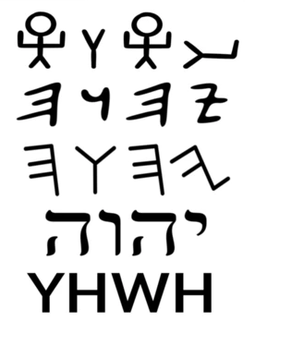 There he is - there are two of them. The first line shows what looks like two people with their hands up. I see the father and the son together - Yahweh and Yahshua. Some translate this as, 'Behold, nail, behold hand'.
Praise Yah and the name and works of His son.